
The world's largest collection of historic British cars


The world's largest collection of historic British cars
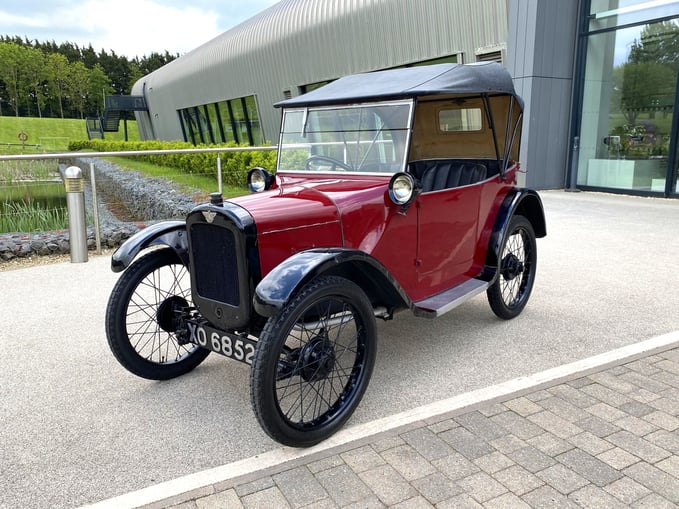
The ‘Seven’ is Austin’s most famous car and was designed with great urgency from 1920 by Sir Herbert Austin and Stanley Edge in response to the company’s severe financial crisis.
After a failed model launch after the First World War, Austin desperately needed a new strategy. Sir Herbert Austin’s fellow directors did not share his belief that there was a market for a small car, so he carried out the project himself. He employed an 18-year-old draughtsman from Longbridge, Stanley Edge, to help.
The Seven’s design was finished by 1922, reportedly carried out on Austin’s billiard table at his home Lickey Grange near Bromsgrove. The inspiration was to design the Seven as a large car in miniature, able to carry two adults and two children and affordable for families.
All the early Sevens had open bodywork like this ‘Chummy’ tourer. It had a water-cooled 4-cylinder engine, brakes on all four wheels (of questionable efficiency) and could do up to 50 miles per gallon.
The new ‘Baby Austin’ economy car was an enormous success and saved the company. It brought motoring to the masses on a scale not seen since the launch of Ford’s Model T and revolutionised car ownership in the 1920s. Later, saloons joined the range and the chassis grew longer. It was also the inspiration for several foreign manufacturers, such as BMW's Dixi, the French Rosengart and the Japanese Datsun Seven which were made under licence.
Apart from the T, the Seven was Britain’s cheapest ‘real’ car until 1927 and at the end of production run in 1939 290,000 had been made.














.png)