
The world's largest collection of historic British cars


The world's largest collection of historic British cars
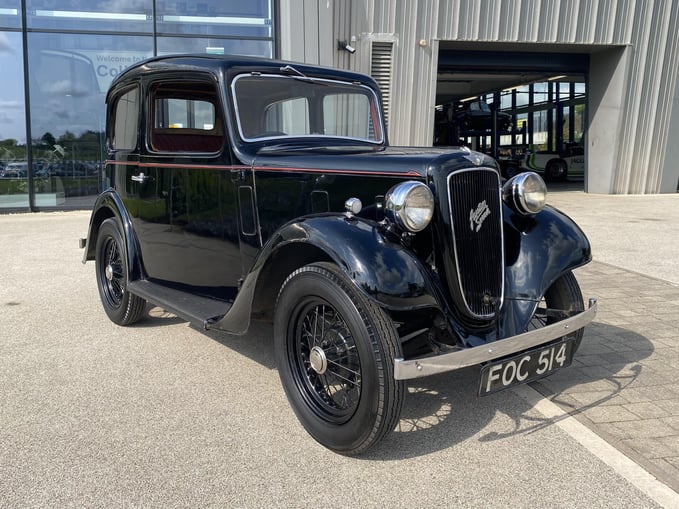
The Ruby was one of three models, along with Opal and Pearl, that were part of a revised range of Sevens introduced in August 1934 and known as Austin’s ‘cheap jewellery’.
This fresh set of designs attempted to update the look of the hugely popular Seven that had been in production since 1922 but had begun to look out-of-date. Radical new features included the cowled radiator on a more streamlined body, a double-dropped low chassis frame and a synchronised second gear. For 1937 the engine was redesigned with a three main-bearing crankshaft.
The original square-rigged Austin Sevens had sold nearly 200,000 by the time of the 1934 face lift and almost 100,000 of the new models were sold by the time production stopped in Spring 1939.
In these last years, most of the Sevens that were made were the Ruby saloon. One new model, the Big Seven, was introduced in a short-lived attempt to update the basic Austin Seven concept but it was unsuccessful and disappeared when the modern, conventional Eight was introduced. The basic Austin Seven layout, draughted by Sir Herbert Austin and Stanley Edge in 1920, therefore prevailed throughout its successful, twenty-year life.















.png)